
Polyurethane elastomer products are widely used in industrial fields such as tires, screen plates, rubber rollers, oil seals, and sealing rings. Due to the high reactivity of raw materials and strict requirements on temperature control and stirring, elastomer equipment requires high specialization in design and operation. The following are some common questions that customers encounter during purchase and use, and we will answer them here.
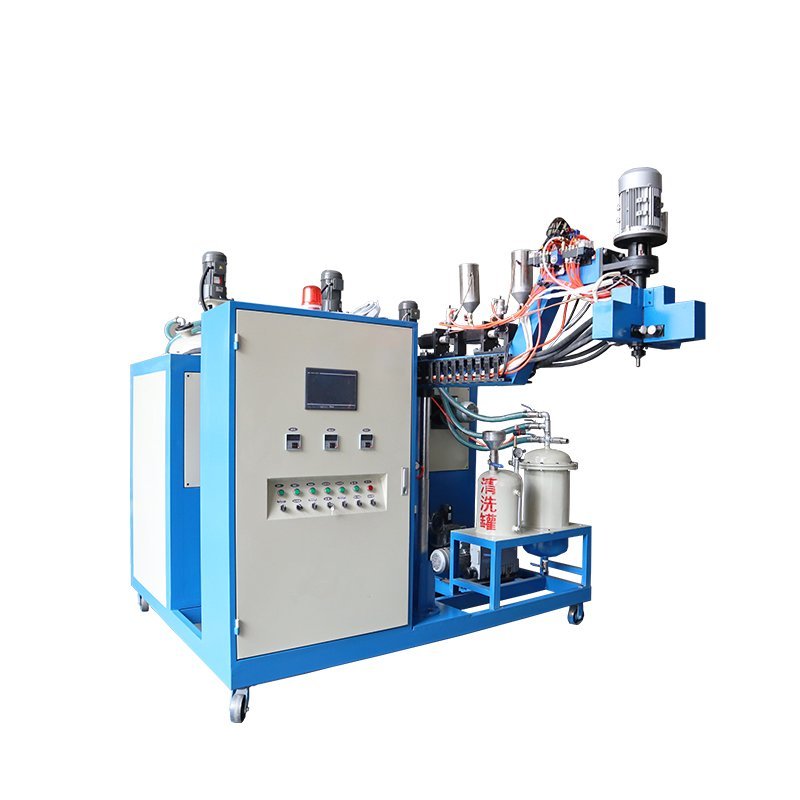
How are elastomer valves driven?
The elastomer metering valves in our equipment are all pneumatically controlled and have the following features:
- Fast response and good sealing;
- Easy to integrate with PLC to achieve fully automatic process control;
- Suitable for high viscosity, fast reaction systems.
Is the pigment circulated before being injected into the mixing chamber?
Yes. The pigment system is equipped with a reflux circulation pipeline to ensure uniform flow of the color paste, avoid sedimentation and stratification, and effectively improve the color consistency of the final product, especially for elastomer products with high color requirements.
What are the key components of an elastomer mixing head?
Our high-performance mixing heads integrate several core functions, including:
- Temperature sensor : monitor head temperature in real time;
- Electric heating tube : keep the raw materials in a suitable active state;
- Stirring blades and stirring sleeves : dynamic mixing to improve dispersion uniformity;
- Hopper/funnel structure : convenient for feeding and diversion;
- Sealing and lubrication components : maintain long-term stable operation.
Why must the elastomer mixing head be heated?
Elastomer materials such as TDI, MOCA, MDI, etc. are very easy to crystallize and solidify at room temperature. If the die head is not heated, the residual material will block the stirring system after shutdown, and the cleaning cost is extremely high. Therefore, heating can:
- Maintain the activity of the liquid;
- Reduce the risk of residual curing;
- Improve the efficiency of equipment shifts;
- Reduce maintenance frequency.
How to maintain elastomer equipment after use?
Depending on the length of downtime, the maintenance method is slightly different:
Short shutdown (overnight) : drain the MOCA material and vacuum seal the TDI;
Long downtime :
- TDI: extract and add DOP for cleaning;
- MOCA: Completely empty;
- MDI system (such as ABC three-tank structure): all need to be stored in a vacuum.
Good downtime maintenance is the key to ensure accurate measurement and smooth response next time.
What are the steps involved in the elastomer mold use process?
Mold use usually includes two key steps:
Preheat :
- Mold temperature: 80–110°C
- TDI tank: heated to 80°C
- MOCA tank: heated to 120°C
Spraying release agent : ensure that the product is easy to demould and has a smooth and consistent surface.
What is the difference between the simple elastomer machine and the standard one?
Simple equipment is mainly suitable for users with limited budget, moderate production or experimental users. The key differences are as follows:
| Configuration items | Simple | Standard |
| Metering motor | Infinitely variable speed | Servo/frequency control |
| MOCA Processing | No MOCA melting tank | Electromagnetic heating melting system |
| Heating method | Hot air/electric heating tube | Hot oil pump + pipe in pipe |
| Sealed structure | Oil seal | Mechanical seal + lubricating oil circulation |
| Display | 7 inches | 10-inch touch screen |
| Machine head | Fixed, non-adjustable | Can move left and right |
| Loading platform/ladder | none | Standard |
What are the characteristics of the stirring structure of MDI elastomers?
The mixing head of the MDI system adopts a dynamic and static double-layer interlocking stirring structure , and the stirring sleeve has teeth to improve the shear mixing ability;
The stirring head also has teeth , forming internal and external dual-power stirring . The overall effect is stronger and is suitable for systems with fast reaction speed and large viscosity difference.
What flow rate is generally used for small elastic wheels?
For small elastic wheels, handrails, and elastic pads, two-component elastomer equipment with a common flow rate of 1-3 kg/s is sufficient to meet production needs.
How can low-end equipment process MOCA raw materials?
If the equipment is not equipped with an automatic MOCA melting tank, the following methods can be used: manually melt the MOCA using an induction cooker ; manually pour it into the insulation tank and then perform the metering operation.
This method is suitable for trials, small production lines or customers with low MOCA usage.
What are the heating methods for elastomer equipment?
There are two main categories:
- Hot air heating : suitable for simple or small and medium-sized equipment;
- Hot oil circulation heating : uniform heating and high temperature control accuracy are the mainstream configurations of standard equipment.
How to choose between two-component and three-component elastomer machines?
This depends on your process recipe and raw material structure:
- Two components : commonly found in TDI+MOCA or MDI+crosslinker systems;
- Three components : suitable for adding additives, fillers, toughening agents and other special formulas, such as A+B+C structure.
At pufoammachine.com we can customize complete sets of equipment with different structures according to the recipe.
Want to know more? Welcome to contact us!
We can provide you with a complete solution including elastomer host, supporting molds, heating system, color paste system , etc. If you encounter special problems during use, please feel free to contact us.