
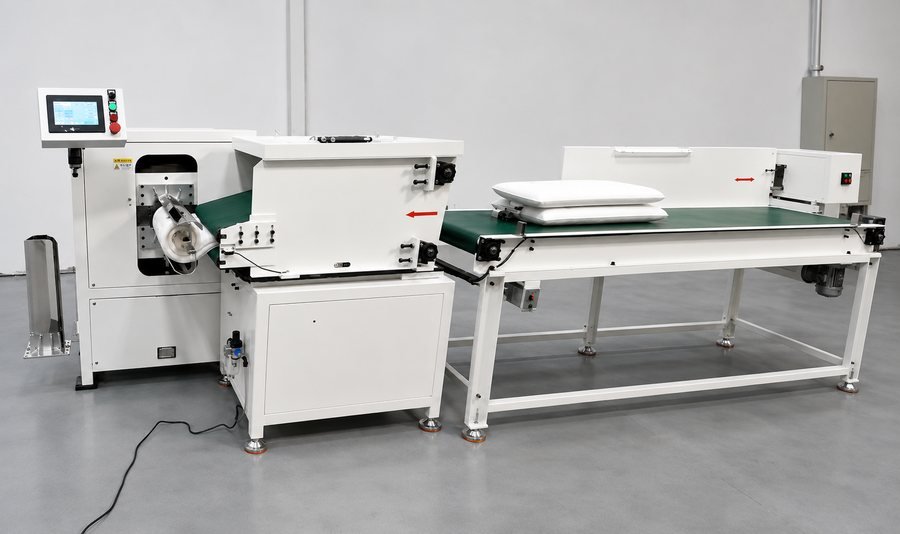
What This Machine Does
Why Pillow Lines Use Roll-Packing & Compression
Flexible and memory PU foam is viscoelastic — it can be compressed well below its molded size and will recover its shape once the compressive wrap or vacuum seal is removed. This is the same principle used across the foam bedding industry for compressed, roll-packed mattress and pillow shipping (the "bed-in-a-box" model), and it is why roll-packing sits at the end of a pillow line, after punching and any bagging step have already been completed.
Compression Shipping vs. Standard Box Packing
| Compressed roll-pack | Standard, uncompressed box | |
|---|---|---|
| Shipped volume | Reduced — more units per container/carton | Full pillow volume, one-to-one with carton size |
| Handling | Needs a roll-pack/compression step on the line | No extra compression step required |
| Customer experience | Pillow must be unwrapped and allowed to recover its shape | Pillow is ready to use straight from the box |
| Best suited to | Long-distance or high-volume export shipping where freight cost matters | Short-distance distribution or retail display where shelf-ready presentation matters |
What to Check Before Adding Compression Packing to a Line
| Question to ask | Why it matters |
|---|---|
| Does the foam fully recover shape after repeated compression? | Not all foam formulations have the same long-term compression-set behavior; confirm this with your own foam formulation rather than assuming it. |
| Is the wrap film moisture- and dust-resistant? | A compressed pillow can sit in transit for weeks; the wrap is its only protection during that time. |
| Does the packing step happen before or after bagging? | Line sequencing affects whether the pillow is compressed inside its retail bag or the bag is added after compression — this changes the wrap/bag material needed. |
| Can the machine handle your full range of pillow sizes? | A compression station sized for one pillow profile may not compress a significantly larger or smaller pillow evenly. |
Adding a compression-packing step to an existing pillow line?
Get a Free QuoteCommon Misunderstandings
- "Compression packing damages foam" — for foam within its designed compression-set tolerance, recovery is expected; the real risk is compressing foam that was never formulated or tested for it.
- "Any wrap film works" — film needs to hold compression for the full transit time and protect against moisture, not just look tight on the day it is packed.
- "Compression packing replaces bagging" — the two solve different problems (volume reduction vs. dust/moisture protection) and many export lines use both.
Where This Fits in a Pillow Line
FAQs
Will a compressed pillow fully return to its original shape?
Foam engineered for compression packing generally does, but recovery behavior depends on the specific foam formulation — confirm this against your own material before committing a whole line to compression packing.
Does roll-packing replace the need for a separate bag?
Not necessarily. Roll-packing reduces shipped volume; bagging protects against dust and moisture. Many export lines use both steps, in whichever sequence suits their packaging materials.
Why do exporters compress-pack pillows instead of shipping them at full size?
Reducing shipped volume lets more units fit in the same container or carton, which lowers freight cost per unit on long-distance or high-volume export shipments.
Is compression packing only used for pillows?
No — the same principle is widely used across the foam bedding industry, including compressed, boxed mattress shipping.
What should I ask a supplier before adding this step to my line?
At minimum: whether your specific foam has been tested for repeated compression recovery, what wrap film is used and how moisture-resistant it is, and whether the station can handle your full range of pillow sizes.