
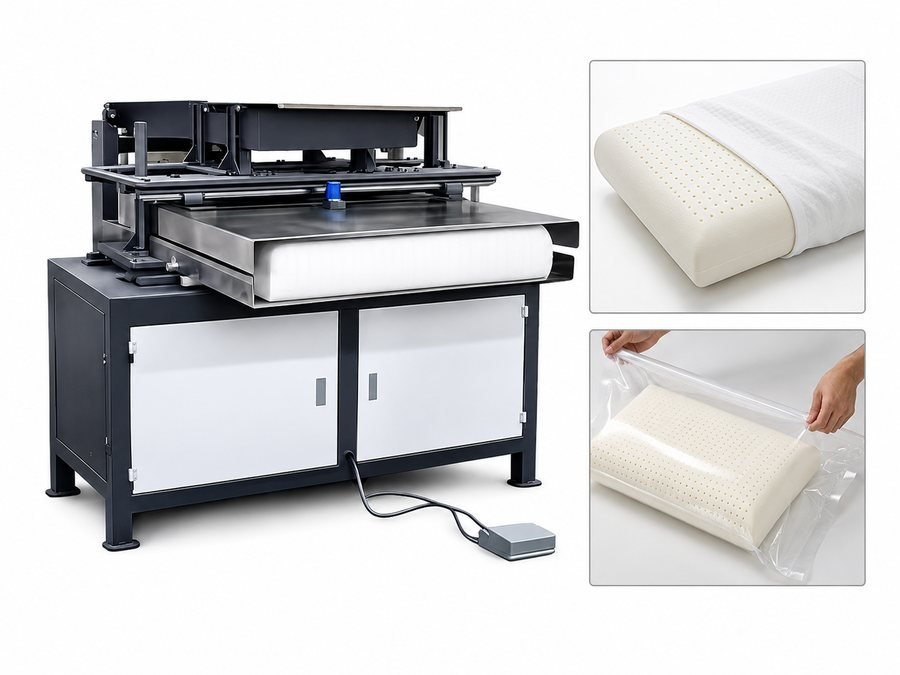
What This Step Does
Why Finished Pillows Get Bagged Before Export
A pillow leaving the production line still needs to survive cartoning, palletizing and ocean or air freight before it reaches a retail shelf or end customer. A sealed poly bag is the standard first line of protection against dust, moisture and handling marks during that chain, and it also gives warehouse and customs staff a countable, uniform unit for cartoning. Bagging can run as a fully automated line station, a semi-automated station with an operator loading pillows, or a manual finishing step — which configuration suits a given line depends on output volume and budget, and should be confirmed directly rather than assumed from marketing copy.
Bag Styles by Export Channel
| Bag style | Common use case |
|---|---|
| Plain self-seal poly bag | Wholesale/bulk export where the bag is only protective, not retail packaging |
| Printed retail bag with header card | Retail-ready shipments going straight to shelf |
| Vented poly bag | Markets or freight modes where trapped moisture inside a sealed bag is a concern |
Questions to Ask Before Choosing a Bagging Setup
| Question | Why it matters |
|---|---|
| Is the station fully automatic, semi-automatic, or manual? | This determines labor cost per unit and realistic throughput — do not assume "automatic" without confirming with the supplier. |
| Can it switch between bag sizes for different pillow SKUs? | A line running multiple pillow sizes needs a changeover process that does not stall output. |
| Is the bag material moisture- and dust-resistant? | The bag is the pillow’s only protection for the full transit time to the export destination. |
| Does bagging happen before or after compression packing? | Sequencing changes which material (bag or wrap film) needs to survive the compression step. |
Specifying a finishing and packing station for your pillow line?
Get a Free QuoteWhere This Fits in a Pillow Line
FAQs
Is pillow bagging always fully automatic?
No. Bagging can be run as a fully automated station, a semi-automated station with an operator, or a manual step, depending on the line’s output volume and budget. Confirm which configuration you are quoting before assuming full automation.
Why not skip bagging and ship pillows loose in cartons?
Unbagged pillows are exposed to dust, moisture and handling marks throughout cartoning, palletizing and freight, and are harder to count as uniform units — bagging addresses both problems.
What bag material should I use for ocean freight?
It depends on your route and climate exposure; a moisture-resistant bag matters more on longer, humid transit routes, which is worth raising directly with your packaging supplier.
Does bagging happen before or after compression packing?
It depends on the line design — some lines bag first and then compress, others compress first and bag afterward. The choice affects which material (bag or wrap film) has to survive the compression step.
Can one station handle multiple pillow sizes?
Many can, but changeover time between bag sizes varies — worth confirming against your actual SKU mix before assuming a single station covers your full range.