
Choosing the right polyurethane foam machine directly affects production efficiency, foam quality, labor cost, and long-term profitability. Many manufacturers focus mainly on machine price during purchasing, but equipment selection should also depend on production scale, flow output, product type, and automation requirements.
A machine that is too small reduces production efficiency and creates output bottlenecks. A machine that is too large increases unnecessary investment and operating costs. Understanding the differences between high pressure and low pressure foam machines helps manufacturers make more practical investment decisions.
What Is a High Pressure Foam Machine?
High pressure foam machines use impingement mixing technology to combine polyol and isocyanate at high speed. The materials collide inside the mixing chamber under high pressure, usually between 120–200 bar.
Because the system does not rely on mechanical stirring, mixing becomes faster and more uniform. High pressure systems are widely used in industrial environments requiring stable and continuous production.
These machines are commonly used in refrigerator insulation, automotive seating, sandwich panels, and cold room production lines.

What Is a Low Pressure Foam Machine?
Low pressure foam machines use mechanical stirring to mix polyurethane raw materials. Working pressure usually ranges from 6–20 bar depending on machine configuration and application requirements.
The machine structure is simpler compared with high pressure systems, making operation and maintenance easier. Many small and medium manufacturers choose low pressure machines because they provide greater flexibility and lower investment cost.
Low pressure systems are commonly used in sofa cushions, memory foam pillows, packaging foam, and custom molded products.
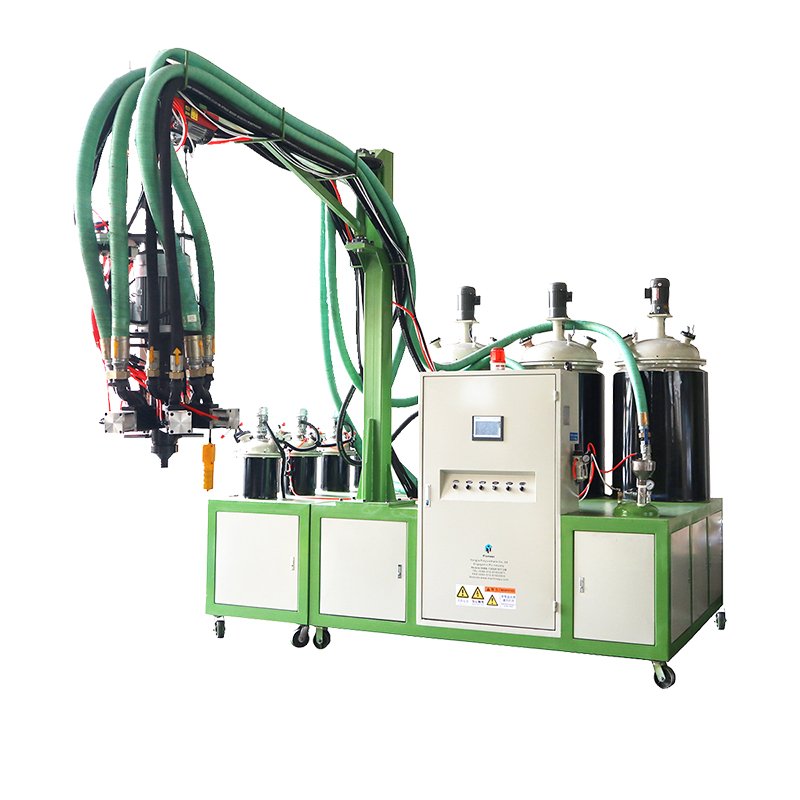
Core Differences Between High and Low Pressure Machines
Although both systems produce polyurethane foam, their working principles and production capabilities differ significantly.
High pressure machines focus on automation, efficiency, and continuous production. Low pressure machines focus more on flexibility and lower operating complexity.
Understanding these differences helps manufacturers select equipment that matches actual production needs.
| Item | High Pressure Machine | Low Pressure Machine |
| Mixing Method | Impingement mixing | Mechanical mixing |
| Pressure Range | 120–200 bar | 6–20 bar |
| Cleaning Method | Self-cleaning | Manual cleaning |
| Automation Capability | High | Medium |
| Production Efficiency | Higher | Lower |
| Initial Investment | Higher | Lower |
| Maintenance Complexity | Higher | Lower |
| Suitable Production Scale | Medium/Large | Small/Medium |
Production Scale Is the Main Decision Factor
Production scale is usually the most important factor when selecting between high pressure and low pressure foam machines.
Small factories prioritize flexibility and lower startup costs. Large industrial factories require higher efficiency, stable foam quality, and automated production systems.
Choosing equipment that matches production volume improves operational efficiency and reduces long-term production risk.
Low Pressure Machines for Small-Scale Production
Small-scale production environments usually involve frequent product changes, smaller batch sizes, and lower daily output volumes.
In these situations, low pressure foam machines provide better flexibility because operators can easily adjust formulations and mold configurations.
The simpler machine structure also reduces maintenance complexity and technical training requirements.
Typical Applications
- Sofa cushions
- Memory foam pillows
- Packaging foam
- Decorative molded foam
- Small custom products
Typical Small Factory Investment
Low pressure production systems usually require lower startup investment compared with industrial high pressure systems.
Smaller businesses often prioritize fast ROI and manageable operating costs during early factory development.
| Equipment | Estimated Price |
| Basic Low Pressure Machine | USD 8,000–18,000 |
| Air Compressor | USD 1,000–3,000 |
| Material Tanks | USD 2,000–5,000 |
| Mold Set | USD 2,000–8,000 |
| Total Investment | USD 15,000–35,000 |
High Pressure Machines for Large-Scale Production
Large industrial production environments require faster cycle times, stable foam density, and continuous operation capability.
High pressure foam machines support automated production lines, robotic pouring systems, and conveyor integration. These features improve production consistency and reduce labor dependence.
Because high pressure mixing is more uniform, foam structure stability also improves in large-scale production environments.
Industries That Prefer High Pressure Machines
High pressure systems dominate industries requiring strict insulation performance and stable dimensional consistency.
Large production lines often operate continuously for many hours every day, making automatic cleaning and pressure stability extremely important.
Common Applications
- Refrigerator insulation
- Cold room panels
- Automotive seating
- Sandwich panels
- Industrial insulation systems
Flow Output Determines Production Capacity
Flow output is one of the most important technical parameters in foam machine selection. It directly affects pouring speed, production capacity, and cycle efficiency.
Machines with insufficient flow output may slow production and create unstable foam filling performance. Oversized systems increase unnecessary investment and reduce efficiency in smaller production environments.
Manufacturers should match flow capacity to actual production demand instead of selecting machines only by maximum power.
Typical Flow Range Comparison
| Machine Type | Flow Range | Suitable Factory Type |
| Small Low Pressure Machine | 5–30 g/s | Small workshops |
| Medium Low Pressure Machine | 30–100 g/s | Medium factories |
| Standard High Pressure Machine | 100–300 g/s | Large factories |
| Large High Pressure Machine | 300–500+ g/s | Continuous industrial lines |
Risks of Choosing the Wrong Flow Range
Undersized machines create production bottlenecks and longer cycle times. They may also produce unstable foam density when operating beyond designed capacity.
Oversized equipment creates higher electricity consumption, unnecessary equipment cost, and lower operating efficiency for smaller projects.
A proper balance between current production needs and future expansion plans is essential.
Product Type Also Affects Machine Selection
Different polyurethane products require different production methods and equipment characteristics.
Flexible foam products usually prioritize softness and formulation flexibility. Rigid foam products require stable insulation performance and dimensional consistency.
Automotive and industrial products often require higher precision and repeatable production cycles.
Flexible Foam Production
Flexible foam production includes furniture cushions, mattresses, pillows, and packaging materials.
These applications usually involve smaller pouring volumes and more frequent product adjustments, making low pressure machines more suitable.
Low pressure systems also simplify formulation changes for different comfort and density requirements.
Rigid Foam Production
Rigid foam applications include refrigerators, insulation panels, cold rooms, and industrial insulation systems.
These industries usually require higher foam consistency, stable cell structure, and continuous production speed.
High pressure systems provide better mixing precision and more stable insulation performance in these environments.
Integral Skin and Elastomer Products
Integral skin products include automotive armrests, steering wheels, and seating components. PU elastomer products include industrial wheels and rollers.
These products require precise metering and stable molding performance. High pressure machines generally provide better repeatability for these applications.
Automation Requirements
Automation level strongly influences equipment selection. Small workshops may still rely mainly on manual operation, while industrial factories increasingly adopt automated production systems.
High pressure machines integrate more easily with robotic pouring systems, conveyor lines, and automated mold handling systems.
Low pressure machines remain suitable for flexible production environments where product switching occurs frequently.
Manual and Semi-Automatic Production
Manual production environments usually prioritize flexibility and lower equipment investment.
Low pressure machines are often sufficient for small workshops and custom production lines where operators manually handle molds and pouring operations.
Semi-automatic production may use conveyors or simple mold carriers while maintaining relatively flexible production capability.
Fully Automated Production
Fully automated production lines require stable pressure systems, automatic cleaning, and continuous output capability.
High pressure systems support robotic integration and reduce labor requirements during long-term industrial production.
These systems are commonly used in refrigerator, automotive, and sandwich panel factories.
Equipment Investment Comparison
Equipment price varies significantly between low pressure and high pressure systems.
Although high pressure systems require larger initial investment, they often reduce long-term labor cost and improve production efficiency in large-scale operations.
Manufacturers should evaluate total operating cost rather than focusing only on purchase price.
| Equipment Type | Estimated Price |
| Basic Low Pressure Machine | USD 8,000–20,000 |
| Advanced Low Pressure Machine | USD 20,000–50,000 |
| Standard High Pressure Machine | USD 35,000–120,000 |
| Automated High Pressure Production Line | USD 300,000–2,000,000+ |
Operating Cost Comparison
Operating costs include labor, electricity, maintenance, spare parts, and material waste.
Low pressure systems reduce startup investment but generally require more manual cleaning and operator involvement.
High pressure systems consume more energy but reduce labor requirements and material waste during long-term production.
| Cost Item | Low Pressure Machine | High Pressure Machine |
| Electricity | Lower | Higher |
| Labor Requirement | Higher | Lower |
| Cleaning Time | Longer | Shorter |
| Material Waste | Higher | Lower |
| Maintenance Complexity | Lower | Higher |
ROI Considerations
Low pressure machines often provide faster ROI for small factories because of their lower startup investment.
High pressure systems become more economical when production volume increases and automation becomes necessary.
Factories with continuous large-volume production usually recover investment through higher efficiency and reduced labor costs.
Maintenance Differences
Maintenance requirements differ significantly between the two machine types.
High pressure systems require hydraulic system maintenance, seal replacement, and high-pressure component inspection. Low pressure systems mainly require stirring system cleaning and basic mechanical maintenance.
Choosing equipment with reliable supplier support reduces long-term downtime risk.
Importance of Technical Support
Technical support strongly affects long-term production stability.
Manufacturers should evaluate supplier capabilities in installation, operator training, spare parts supply, and troubleshooting support before purchasing equipment.
Reliable after-sales service becomes especially important for automated industrial production lines.
Common Mistakes When Choosing Foam Machines
Many manufacturers select equipment based only on purchase price while ignoring production requirements and long-term operating costs.
Other factories purchase oversized industrial systems before achieving stable production demand, creating unnecessary financial pressure.
Some companies also attempt mass production using small low pressure machines, resulting in efficiency bottlenecks and unstable foam quality.
Recommended Machine Selection by Industry
| Industry | Recommended Machine |
| Furniture | Low pressure |
| Refrigerator insulation | High pressure |
| Automotive seating | High pressure |
| Sandwich panels | High pressure |
| Custom molded products | Low pressure |
Future Trends in Foam Machine Technology
Modern polyurethane foam production increasingly focuses on automation, intelligent control systems, and energy efficiency.
PLC systems, intelligent temperature control, and robotic pouring systems are becoming standard in large industrial factories.
Future foam production lines will also emphasize material waste reduction and environmentally friendly manufacturing technologies.
Choosing between high pressure and low pressure foam machines depends mainly on production scale, flow output, product type, automation requirements, and investment budget.
Low pressure systems are suitable for flexible small-batch production with lower startup investment. High pressure systems provide better efficiency, automation compatibility, and foam consistency for continuous industrial manufacturing.
A clear understanding of actual production needs is essential for selecting the right equipment. Proper machine selection improves foam quality, production efficiency, and long-term profitability.
Low pressure systems are suitable for flexible small-batch production with lower startup investment. High pressure systems provide better efficiency, automation compatibility, and foam consistency for continuous industrial manufacturing.
A clear understanding of actual production needs is essential for selecting the right equipment. Proper machine selection improves foam quality, production efficiency, and long-term profitability.
Related guide: How to Choose a Car Seat Foam Production Line — machine class, mold count, output planning and the density, ILD and ISO 3795 quality checks.