
Polyurethane production efficiency depends heavily on machine selection. A machine that matches your production scale improves foam quality, reduces waste, and supports long-term factory growth.
Many manufacturers focus only on machine price during purchasing. In reality, production capacity, automation level, formulation stability, and maintenance costs are equally important.
Whether you produce furniture foam, refrigerator insulation, automotive parts, or industrial panels, selecting the correct PU injection machine can significantly affect profitability and production stability.
What Is a PU Injection Machine?
A PU injection machine mixes polyol and isocyanate at a controlled ratio before injecting the material into molds, cavities, or production lines. The chemical reaction creates polyurethane foam or elastomer products.
These machines are widely used in flexible foam, rigid foam, integral skin foam, spray foam, and elastomer production. Different industries require different machine configurations and pressure systems.
Modern polyurethane injection machines combine metering systems, mixing heads, temperature control units, PLC systems, and raw material circulation systems to achieve stable production performance.
Main Types of PU Injection Machines
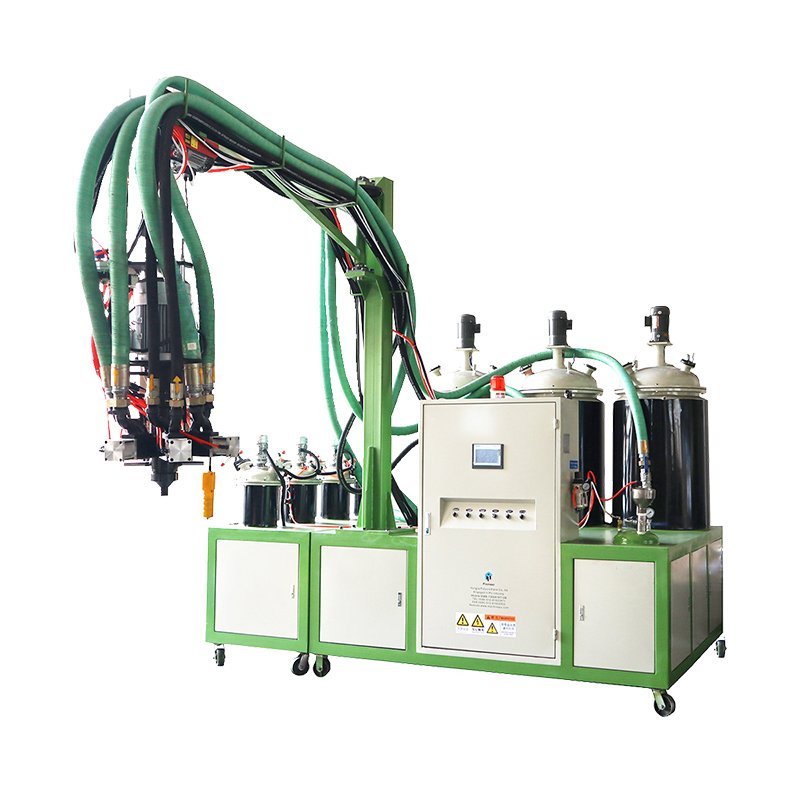
High Pressure PU Injection Machines
High pressure PU foam machines use impingement mixing technology. Polyol and isocyanate collide at high speed inside the mixing chamber, creating uniform mixing without mechanical stirring.
This system usually operates between 120–200 bar. It supports continuous production, automatic cleaning, and highly consistent foam structures.
High pressure equipment is commonly used in refrigerator insulation, automotive seating, sandwich panels, and large-scale industrial foam production.
Typical Features
- Self-cleaning mixing head
- High automation capability
- Stable density control
- Reduced raw material waste
- Faster production cycles
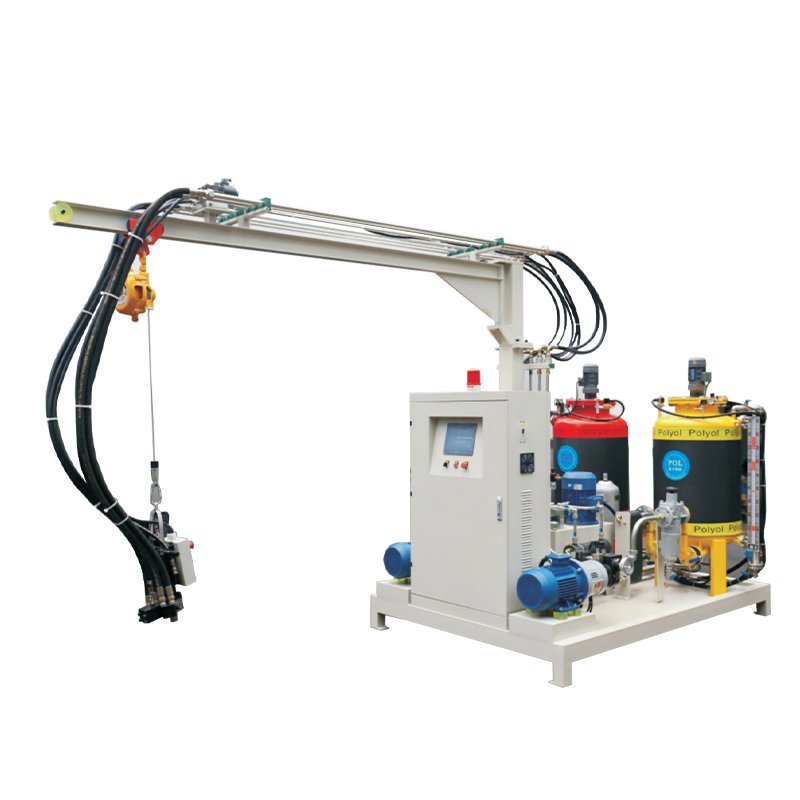
Low Pressure PU Injection Machines
Low pressure machines use mechanical stirring to mix materials. The system structure is simpler and easier to maintain compared with high pressure systems.
These machines are suitable for flexible production environments, custom products, and smaller manufacturing volumes. Many furniture factories use low pressure systems for sofa and cushion production.
Low pressure equipment usually works at 6–20 bar and allows easier formulation adjustments for different products.
Typical Features
- Lower investment cost
- Easier operation
- Flexible formulation adjustment
- Suitable for custom production
- Lower maintenance complexity
High Pressure vs Low Pressure Machine Comparison
| Item | High Pressure Machine | Low Pressure Machine |
| Mixing Method | Impingement mixing | Mechanical mixing |
| Working Pressure | 120–200 bar | 6–20 bar |
| Automation Level | High | Medium |
| Cleaning Method | Self-cleaning | Manual cleaning |
| Production Scale | Medium to large | Small to medium |
| Foam Consistency | Excellent | Good |
| Maintenance Complexity | Higher | Lower |
| Initial Investment | Higher | Lower |
| Labor Requirement | Lower | Higher |
Why Manufacturing Scale Matters
Machine selection should begin with production scale analysis. A startup factory and a large automated production plant require completely different equipment solutions.
Oversized equipment increases unnecessary investment and operating costs. Undersized equipment creates production bottlenecks and limits future expansion.
Factories should evaluate both current production volume and future growth plans before purchasing polyurethane equipment.
Small-Scale Production Requirements
Small-scale factories often focus on flexibility and lower startup investment. These businesses may produce custom furniture, molded cushions, packaging foam, or prototype products.
Production volumes are usually lower, and operators frequently change molds or formulations. In this environment, machine flexibility becomes more important than maximum output speed.
Low pressure PU injection machines are usually the best solution for small factories because they reduce investment pressure while maintaining acceptable foam quality.
Typical Small Factory Investment
| Equipment | Estimated Price |
| Basic Low Pressure PU Machine | USD 8,000–18,000 |
| Simple Foam Mold Set | USD 2,000–10,000 |
| Air Compressor | USD 1,000–3,000 |
| Material Tanks | USD 2,000–5,000 |
| Total Initial Investment | USD 15,000–40,000 |
Medium-Scale Production Requirements
Medium-sized manufacturers usually require higher production efficiency while maintaining some flexibility for different product types.
Factories at this stage often produce sofas, mattresses, automotive cushions, or insulation products with stable monthly demand.
Advanced low pressure systems or entry-level high pressure machines become more suitable because they improve cycle stability and reduce labor dependence.
These factories also begin integrating conveyors, automatic mold carriers, and robotic pouring systems into production.
Large-Scale Production Requirements
Large factories prioritize production speed, automation, consistency, and long-term operating efficiency. Downtime and unstable foam quality can create significant financial losses.
High pressure PU injection machines dominate this market because they support automated production lines and continuous operation environments.
Large-scale refrigerator and automotive factories often combine high pressure machines with robotic systems, conveyor systems, and automatic demolding equipment.
Typical Large Factory Investment
| Equipment | Estimated Price |
| High Pressure PU Machine | USD 35,000–120,000 |
| Cyclopentane Foaming System | USD 80,000–250,000 |
| Automatic Conveyor Line | USD 50,000–300,000 |
| Robotic Pouring System | USD 40,000–150,000 |
| Mold Systems | USD 20,000–200,000 |
| Complete Production Line | USD 250,000–1,500,000+ |
Choosing Machines Based on Product Type
Flexible Foam Production
Flexible foam products include sofas, mattresses, pillows, and cushions. These products usually require adjustable density and softness.
Low pressure machines are common in flexible foam production because manufacturers often change formulations and mold sizes.
Large furniture factories may still choose high pressure systems to improve production consistency and reduce labor costs.
Rigid Foam Production
Rigid polyurethane foam is widely used in refrigerators, cold rooms, insulation panels, and construction materials such as decorative faux stone panels.
These applications require stable cell structure, accurate density control, and excellent thermal insulation performance.
High pressure machines are preferred because they deliver more consistent mixing and support continuous industrial production.
Integral Skin and Elastomer Products
Integral skin products include automotive armrests, steering wheels, and seating components. Elastomer products include wheels, rollers, and industrial components.
These products demand accurate metering, stable pressure control, and repeatable molding performance.
High pressure systems often provide better dimensional consistency for these applications.
Automation Requirements
Automation level directly affects labor costs and production efficiency. Small factories may still rely heavily on manual operation, while large factories require full automation.
Semi-automatic production lines typically include conveyor systems and automatic material dosing. Fully automatic systems integrate robots, mold carriers, and PLC control systems.
Higher automation increases initial investment but reduces labor dependence and improves long-term production consistency.
| Automation Level | Typical Application | Estimated Investment |
| Manual Production | Small workshops | USD 10,000–30,000 |
| Semi-Automatic Line | Medium factories | USD 50,000–300,000 |
| Fully Automated Line | Large industrial production | USD 500,000–2,000,000+ |
Factory Layout and Space Planning
Many buyers underestimate the importance of factory layout during equipment selection. Production efficiency depends not only on the machine itself but also on material flow and operator movement.
Factories should reserve enough space for raw material storage, machine maintenance, mold handling, and future expansion.
Large production lines may also require ventilation systems, explosion-proof systems, and dedicated temperature control areas.
Common Mistakes When Choosing PU Injection Machines
Choosing Only Based on Price
Some manufacturers choose the cheapest machine without considering long-term operating costs. Lower-quality machines often increase raw material waste and maintenance frequency.
Over several years, unstable production can cost far more than the original equipment savings.
Ignoring Future Expansion
Factories sometimes purchase equipment that only meets current demand. When orders increase, production capacity quickly becomes insufficient.
Upgrading later may require replacing entire production systems, increasing future investment costs.
Overbuying Automation
Not every factory needs a fully automated production line. Excessive automation can create unnecessary financial pressure for smaller businesses.
Factories should balance investment scale with actual production requirements.
Long-Term Operating Cost Analysis
Equipment cost is only part of the total investment. Manufacturers must also consider labor, electricity, maintenance, spare parts, and material waste.
High pressure machines usually consume more energy but reduce labor requirements and foam defects. Low pressure systems cost less initially but may require more manual operation.
Estimated Annual Operating Costs
| Cost Item | Low Pressure Machine | High Pressure Machine |
| Electricity | USD 2,000–6,000 | USD 5,000–15,000 |
| Maintenance | USD 1,000–3,000 | USD 3,000–10,000 |
| Spare Parts | USD 800–2,500 | USD 2,000–8,000 |
| Labor | USD 15,000–60,000 | USD 8,000–40,000 |
| Material Waste | Higher | Lower |
How Yongjia Supports Different Manufacturing Scales
As a polyurethane solution provider, Yongjia Polyurethane Co., Ltd. supplies high pressure machines, low pressure machines, spray foam equipment, molds, raw materials, and complete production lines.
Yongjia supports flexible customization based on factory capacity, product type, and automation requirements. The company also provides installation guidance, technical training, and long-term after-sales support.
For refrigerator, furniture, automotive, and insulation panel production, integrated equipment planning helps customers reduce project risks and improve production efficiency.
Future Trends in PU Injection Machine Technology
The polyurethane industry is moving toward smarter and more energy-efficient production systems.
Modern equipment increasingly uses PLC automation, touchscreen interfaces, intelligent temperature control, and data-driven production monitoring.
Future factories will focus more on automated defect detection, energy optimization, and integrated production management systems.
There is no universal PU injection machine suitable for every manufacturer. The best choice depends on production scale, product type, automation goals, factory layout, and long-term business plans.
Small factories usually benefit from flexible low pressure systems, while large industrial manufacturers often require fully automated high pressure production lines.
Careful equipment selection improves foam quality, reduces production costs, and supports long-term factory growth. Working with an experienced polyurethane solution provider can help manufacturers build more stable and competitive production systems.
Related guide: Polyurethane Foam Machines: The Complete Guide — high vs low pressure dosing, key components, sizing and selection.